
What Is USB PD Charging? A Complete Guide to USB Power Delivery
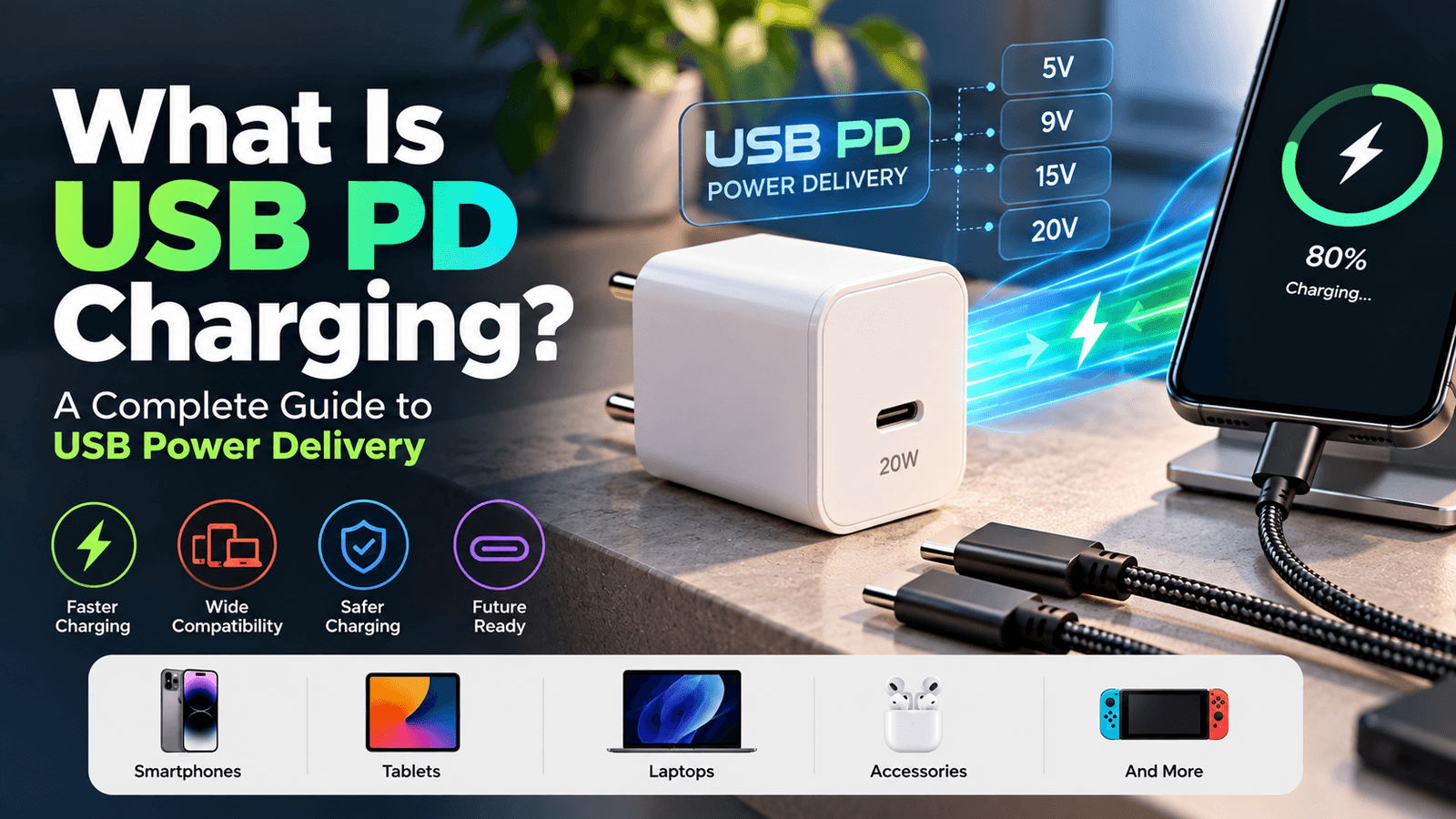
In today's fast-paced world, smartphones, tablets, laptops, and other electronic devices have become an essential part of our daily lives. With the increasing use of these devices, fast charging has become an important feature for people who want to spend less time connected to a charger. One technology that has made modern charging more efficient and versatile is USB Power Delivery, commonly known as USB PD. But what exactly is USB PD charging, how does it work, and why is it important when choosing a charger or cable? In this blog, we'll explain everything you need to know about USB PD charging in simple language and help you understand how the right charging accessories can improve your everyday experience.
- What Is USB PD Charging?
USB PD stands for USB Power Delivery, a charging technology that allows compatible devices and chargers to negotiate the amount of electrical power required. Unlike basic USB charging, which may operate at a fixed power level, USB PD supports different voltage and current combinations depending on the device and charging equipment. This makes it possible to charge a wide range of products, from smartphones and wireless accessories to tablets and compatible laptops, using suitable USB-C charging equipment. The actual charging speed depends on the capabilities of the device, charger, cable, and supported charging standards.
- How Does USB Power Delivery Work?
USB Power Delivery works through communication between a compatible charger and the connected device. When you plug your smartphone into a USB PD charger, the device and charger negotiate an appropriate power level based on their supported capabilities. The charger doesn't simply force its maximum wattage into the phone. Instead, the compatible system determines which power profile can be used. For example, a 20W PD charger may provide power to a compatible smartphone at a suitable level, while a device with different charging requirements may use a different power level. This negotiation helps compatible devices receive the power they are designed to handle.
- Is USB-C the Same as USB PD?
USB-C and USB PD are related, but they are not the same thing. USB-C refers to the physical connector and port design, while USB Power Delivery is a charging and power negotiation technology. A USB-C port does not automatically mean that a device or charger supports USB PD. Some USB-C cables and chargers may support basic charging, while others support higher power levels and specific charging protocols. Before purchasing a fast charger, it's important to check whether both your device and charger support USB PD. You should also verify that the cable is suitable for the required power level.
- What Are the Benefits of USB PD Charging?
One of the main benefits of USB PD charging is its flexibility. Compatible USB PD chargers can support different power levels, making the technology useful for a variety of devices. Depending on the charger's design and output capabilities, a single USB-C PD charger may be suitable for charging a smartphone, tablet, or compatible laptop. USB PD can also reduce the need to carry separate chargers for different devices. However, the actual benefit depends on the devices you own and whether they support compatible charging standards. USB PD is not a guarantee of faster charging in every situation, but it provides a standardized approach to power delivery across supported equipment.
- What Is the Difference Between a Normal Charger and a USB PD Charger?
A basic charger may provide power using fixed output capabilities, while a USB PD charger supports power negotiation with compatible devices. This means a PD charger can select an appropriate supported power profile rather than relying on just one fixed charging output. For instance, a compatible 20W USB PD charger can be used with devices that support USB PD at suitable power levels. A conventional charger without the required PD support may not provide the same charging experience, even if it has a USB-C connector. When selecting a charger, don't focus only on the connector or advertised wattage; check the supported charging protocols and your device's requirements.
- Does USB PD Support Fast Charging for Smartphones?
Yes, USB PD can support fast charging on compatible smartphones. Many modern phones support USB-C-based fast charging technologies, although the exact charging standard varies by manufacturer and model. Some devices may support USB PD directly, while others may require additional proprietary charging technologies to reach their maximum advertised speed. A charger with a higher wattage rating cannot automatically make every smartphone charge faster. For the best results, check your phone's official charging specifications and use a compatible charger and cable. A USB PD charger can provide the intended charging performance when the complete charging setup supports the required standard.
- What Is PPS and How Is It Related to USB PD?
PPS stands for Programmable Power Supply and is an optional feature associated with USB Power Delivery. It allows compatible chargers to adjust voltage and current more precisely within supported ranges, rather than using only fixed power profiles. Some smartphones, particularly those using specific fast charging implementations, can benefit from PPS support. However, not every USB PD charger supports PPS, and a phone's compatibility must be checked separately. If your smartphone requires PPS for a particular charging mode, choosing a charger with USB PD alone may not be sufficient to achieve that mode. Always check the charger's detailed specifications and your phone manufacturer's requirements.
- How Many Watts Can USB PD Deliver?
USB Power Delivery supports a range of power levels, depending on the version, equipment, and supported power specifications. Traditional USB PD implementations commonly support power levels up to 100W, while USB PD Extended Power Range (EPR) can support higher power levels, up to 240W with suitable equipment and configurations. This does not mean every PD charger can deliver 240W. A charger's output rating, the connected device's capabilities, and the cable's power rating all determine the practical charging setup. For smartphones, chargers such as 20W PD models may be appropriate for compatible devices, while tablets and laptops can require significantly different power levels.
- Why Is the Charging Cable Important for USB PD?
The charging cable is an important part of any USB PD charging setup. Even if your charger and smartphone support fast charging, an unsuitable or limited cable may prevent the system from delivering the desired power. USB-C cables have different power capabilities, and some higher-power charging applications require cables with appropriate ratings and, in certain cases, electronic identification. For example, Razix LINK45 is a Type-C to Type-C braided cable designed to support up to 45W under compatible conditions. Before using any cable, check its specifications and make sure they match your charger and device requirements. Choosing a suitable cable can help you get the intended performance from your charging accessories.
- How to Choose the Right USB PD Charger?
When buying a USB PD charger, the first step is to check your smartphone or other device's supported charging standards. Once you know the required power level, look for a charger that supports the appropriate USB PD profiles and, if needed, PPS. You should also consider the number of ports, charger size, warranty, safety features, and the quality of the manufacturer. If you primarily charge a smartphone, a 20W PD charger may be sufficient for a device that supports that power level. If you plan to charge a tablet or laptop, you may need a charger with a higher output rating. The best charger is the one that matches your actual device requirements rather than simply having the highest wattage.
- Razix Ampio 20: 20W PD Type-C Fast Charger
Razix Ampio 20 is a 20W PD Type-C fast charger designed for compatible devices that support the required charging standards. It is intended for everyday charging applications where users want a suitable USB-C power adapter for their smartphone or other compatible equipment. Before purchasing, customers should confirm their device's charging requirements and compatibility with the charger's specifications. Choosing a suitable PD charger can help users take advantage of supported fast charging capabilities without relying on an incompatible power adapter. Razix focuses on providing practical charging accessories for modern device users, and the Ampio 20 is part of its charging product range.
- Common Mistakes to Avoid When Using a USB PD Charger
One common mistake is assuming that every USB-C charger supports the same fast charging standards. Another is purchasing a cable based only on its connector type without checking its power rating. Some users also believe that a 65W or 100W charger will automatically charge every smartphone at that wattage, which is not correct. Your device determines the power it can accept based on its supported capabilities. To get the best experience, use a reliable charger, compatible cable, and a suitable power source. Avoid damaged cables and chargers, and stop using equipment that becomes unusually hot or shows visible signs of damage.
-Frequently Asked Questions About USB PD Charging
1. Is USB PD charging safe for smartphones?
USB PD is designed to support power negotiation between compatible devices and chargers. However, safety depends on the quality and design of the charger, cable, and device. Use reliable products that meet appropriate safety and compatibility requirements.
2. Can I use a 20W PD charger with a phone that supports 10W charging?
A compatible 20W PD charger can be used with a phone that supports a lower charging power, provided the charger and phone support compatible charging standards. The phone will generally draw power according to its supported charging capabilities rather than automatically receiving the charger's maximum output.
3. Does USB PD charge faster than a normal charger?
USB PD can support higher charging power and fast charging on compatible devices, but actual speed depends on the complete charging setup. A PD charger is not automatically faster in every situation.
4. Can a USB PD charger charge a laptop?
Some USB PD chargers can charge compatible laptops, provided the charger delivers the required power and supports the necessary charging standards. Check your laptop manufacturer's specifications before choosing a charger.
5. Is every Type-C cable compatible with USB PD?
Not necessarily. USB-C is a connector type, and cables have different capabilities. Check the cable's power rating and compatibility before using it for a particular USB PD charging application.
- Final Thoughts
USB Power Delivery has become an important charging technology because it enables compatible devices and chargers to negotiate suitable power levels. Whether you're charging a smartphone, tablet, or laptop, understanding USB PD can help you choose the right charging accessories and avoid compatibility issues. A reliable charger, a suitable cable, and a clear understanding of your device's charging requirements are essential for a consistent charging experience. Razix Ampio 20 offers a 20W PD Type-C charging option for compatible devices, while products such as Razix LINK45 provide a cable solution for suitable Type-C charging setups. Before making a purchase, always check compatibility and choose charging accessories that meet your everyday needs.